
The Power of Multi-Agent Orchestration in Claude Code
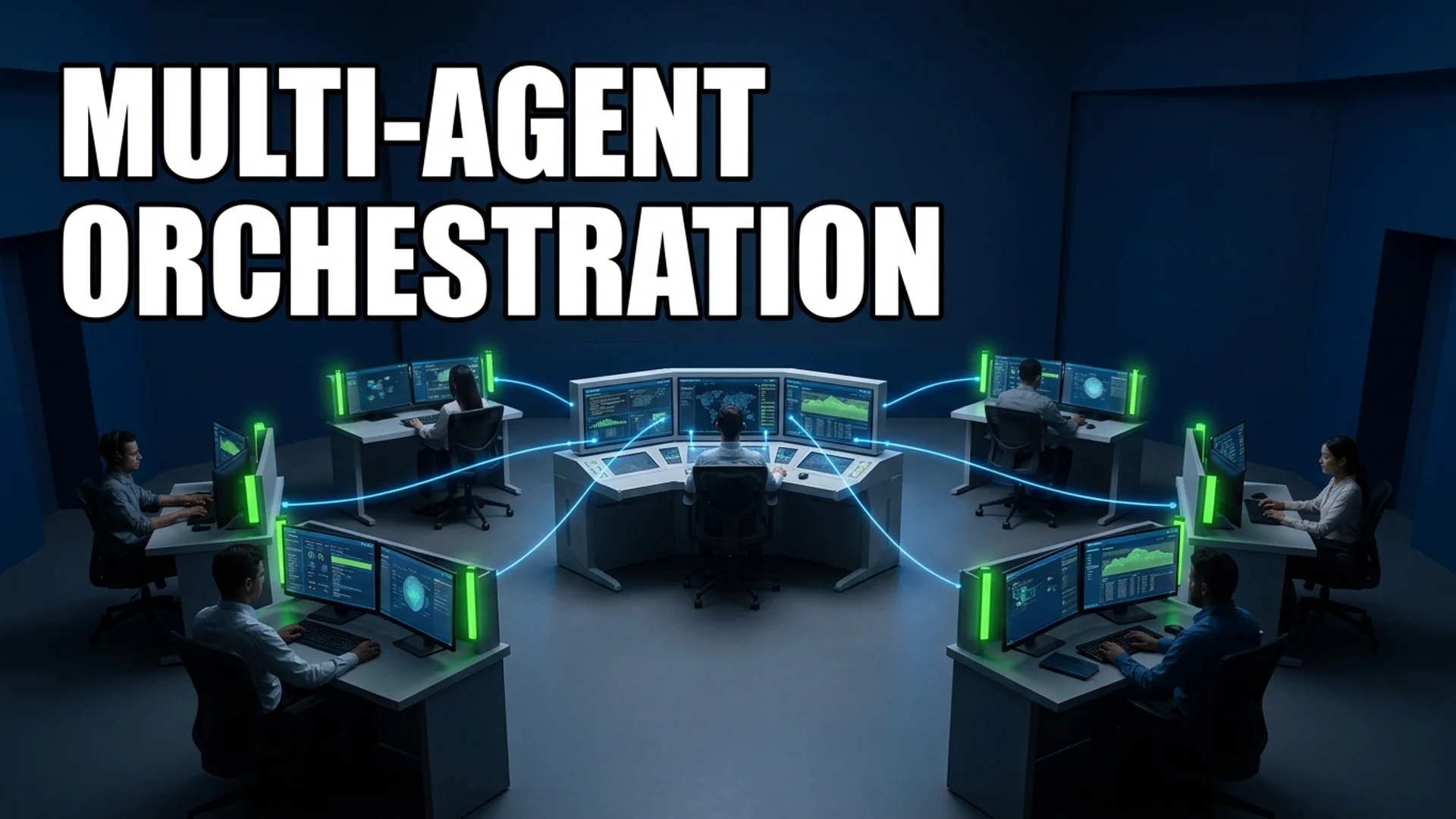
Multi-agent orchestration splits complex tasks across parallel Claude Code agents with isolated memory. A master agent plans and coordinates while subagents execute independently -- solving the single-agent ceiling for large-scale audits, cross-repo sprints, and bulk content generation.
Multi-agent orchestration splits complex Claude Code tasks across parallel agents, each running in isolated memory with focused context. A master agent plans and dispatches work. Subagents execute independently, write results to files, and return a structured status report -- solving the single-agent memory ceiling that crashes large-scale audits, cross-repo sprints, and bulk content generation.
Key Takeaways
- Multi-agent orchestration splits work across multiple Claude Code agents, each with isolated memory and focused context
- A master agent plans and coordinates while subagents execute tasks independently in parallel
- The structured communication protocol keeps the master lightweight by transmitting only summaries and file paths
- 60-file codebase audits complete in parallel batches of 20 instead of crashing a single agent
- Cross-repo sprints execute in parallel with one subagent per repository
- Isolated memory is the core advantage -- focused context produces better output than bloated context
- The jitNeuro framework includes communication protocol templates and orchestration patterns
Why This Matters
If you have used Claude Code for serious work, you have hit the ceiling. A single agent conversation accumulates context with every file read, every search result, and every tool call. Eventually, the agent slows down, loses track of earlier decisions, or in extreme cases crashes the runtime's memory.
This is not a theoretical problem. We hit it scanning 89 files against 26 rules in a single conversation. The JavaScript runtime crashed with a heap memory exhaustion error -- the files were fine, the rules were fine, the single-agent accumulation was the problem.
The solution is the same one that works in distributed systems engineering: split the work across multiple processes. In Claude Code, that means multi-agent orchestration -- a master agent that plans and coordinates, and subagents that execute specific tasks independently in parallel.
The Single-Agent Ceiling Explained
The single-agent ceiling is the point where accumulated context in one Claude Code conversation degrades output quality or crashes the runtime's JavaScript heap.
Claude Code runs in a JavaScript environment with finite heap memory. Every file read, search result, and tool call output adds to the context. A single agent trying to hold an entire codebase audit -- reading 60 files, applying 20+ rules to each, accumulating findings -- hits the heap limit.
The crash is not a model limitation -- it is a runtime limitation. The fix is distributing work across isolated processes, not reducing task scope.
| Approach | Files | Memory Pattern | Result |
|---|---|---|---|
| Single agent | 60 | Accumulates everything in one process | Degraded output or crash |
| Multi-agent (3 subagents) | 20 each | Each agent uses ~1/3 of the memory | All complete successfully |
How Multi-Agent Orchestration Works
In multi-agent orchestration, a master agent plans and coordinates while subagents execute specific tasks independently in their own processes with their own memory.
The architecture has two roles. The master agent plans the work, divides it into batches, dispatches subagents with clear instructions, collects status reports, and consolidates results -- never holding the detail, only the plan and the status. Subagents execute assigned tasks independently, each running in its own process with its own memory, loading only the context needed for its specific task.
"Isolated memory is the core advantage. Focused context produces better output than bloated context -- and it is what prevents the runtime from crashing entirely."
Here is how auditing 60 files for security compliance plays out with orchestration:
- Master agent counts the files (60) and plans batches of 20
- Master spawns 3 subagents, each assigned 20 files and the same ruleset
- Each subagent reads its files, applies rules, writes findings to a summary file, and returns a status line
- Master collects three short status reports and summary file paths
- Master consolidates findings and presents results
The Subagent Communication Protocol
The communication protocol is a structured return format that keeps the master lightweight by transmitting only status, file paths, and a short result -- never raw content.
Without a clear contract, subagents return too much data, the master's context bloats, and you are back to the single-agent problem. Every subagent must return exactly this format:
Key Insight: Structured Returns
Every subagent returns a structured status report: whether it succeeded, what files it changed, and a concise summary of findings. The master never needs to re-read the files -- just the report.
| Return Field | Purpose | Master Behavior |
|---|---|---|
| Status Line | Success, blocked, or partial completion | Determines next action |
| Changed Files | Absolute paths of created/modified files | Scope for commits and PRs |
| Summary Reference | Path to detailed findings | Read only if master needs more detail |
| Short Result | Concise findings, under 15 lines | Enough for consolidation without full context |
A blocked status means the subagent hit a decision it cannot make -- it returns its question and partial work, and the master answers or escalates. A partial status means the subagent completed some work but skipped items, and the master decides whether to dispatch a follow-up agent.
Real-World Multi-Agent Use Cases
Multi-agent orchestration applies to any task that exceeds single-agent memory limits or benefits from parallel execution.
Cross-Repository Sprint Execution
Cross-repo sprints assign one subagent per repository, each loading that repo's context file and implementing its assigned stories independently. A 10-story sprint across 3 repos executes in parallel instead of sequentially. The master maintains the bird's-eye view while subagents handle implementation details.
Bulk Content Generation
Parallel content generation assigns one subagent per topic, each loading the style guide and publishing pipeline instructions. Five posts that would take a single agent 2-3 hours of sequential work complete in under 30 minutes with parallel agents.
Codebase Analysis and Refactoring
Large-scale code changes split files into batches, with each subagent following the same migration pattern independently. The master reviews cross-cutting concerns -- shared middleware, test coverage, type exports -- after all subagents complete.
Deployment Pipeline Monitoring
Background subagents monitor deployment pipelines while the master continues working on the next task. The subagent reports back only when the pipeline completes or fails -- no polling, no context waste in the master.
Architecture Principles for Multi-Agent Orchestration
Four principles govern effective multi-agent orchestration: isolated memory, thin master, fast failure, and per-agent context loading.
Key Insight: Isolated Memory Is the Core Advantage
Each subagent gets a clean JavaScript heap separate from the master and other subagents. This is not a limitation to work around -- it is the mechanism that prevents context accumulation from crashing the runtime AND the reason focused subagents produce higher-quality output than a bloated single-agent conversation.
- Master Stays Thin. The master's job is planning, dispatching, and consolidating. If the master is reading 50 files to understand what subagents did, the orchestration has failed -- the communication protocol exists to prevent this.
- Fail Fast, Report Clearly. Subagents that hit problems return BLOCKED or PARTIAL immediately without heroic workarounds. The master decides how to handle the situation with full context about the overall plan.
- Context Loading Is Per-Agent. Each subagent loads its own context from the layered system (CLAUDE.md, rules, engrams, bundles), so the context hierarchy serves both single-agent and orchestrated multi-agent work.
When NOT to Use Multi-Agent Orchestration
Not every task needs multiple agents. Use single-agent work when the task is small, sequential, minimal context, or interactive.
| Use Single Agent When | Use Multi-Agent When |
|---|---|
| Task under 20 files | Task over 25 files |
| Under 30 minutes of work | Over an hour of single-agent work |
| Highly sequential (B depends on A's exact output) | Parallelizable batches |
| Tight interactive feedback needed | Fire-and-forget subtasks |
| Minimal, focused context | Context would exceed single-agent memory |
Orchestration adds coordination overhead. For small, focused tasks, the overhead is not worth it.
How jitNeuro Codifies Orchestration Patterns
Orchestration -- designing the human-AI boundary in systems -- is the meta-skill that makes multi-agent work effective. The human defines the plan, the boundaries, and the success criteria. AI agents execute within those boundaries independently.
This pattern mirrors how effective engineering teams work: a tech lead defines architecture and assigns work, contributors implement independently, and the team integrates at defined checkpoints. Multi-agent orchestration applies the same management pattern to AI agents.
The jitNeuro open-source framework codifies these patterns:
- Communication protocol templates -- the exact return format subagents must follow
- Batch planning examples -- how to divide work based on file count, repo boundaries, or domain
- Context hierarchy setup -- engrams and bundles that subagents can load independently
- Real-world orchestration patterns from managing 30+ repositories
"Subagents never stall silently. A blocked status returns the question and partial work immediately -- the master decides, not the subagent."
Terms and Glossary
| Term | What It Actually Means |
|---|---|
| Multi-agent orchestration | Splitting work across multiple AI agents that run in parallel, each with isolated memory, coordinated by a master agent. |
| Master agent | The coordinating agent that plans work, dispatches subagents, and consolidates results. Never holds the detail -- only the plan and status. |
| Subagent | An agent spawned by the master to execute a specific task independently. Runs in its own process with its own memory. Returns a structured status report and terminates. |
| Isolated memory | Each subagent gets a clean JavaScript heap separate from the master and other subagents. Prevents context accumulation from crashing the runtime. |
| Communication protocol | The structured return format subagents must follow. Each report includes a status line, changed file paths, a summary reference, and a concise result. Keeps the master lightweight by transmitting summaries, not raw content. |
| Claude Code | Anthropic's CLI tool for AI-powered development. Includes a built-in Agent tool for spawning subagents. |
| jitNeuro | An open-source framework for AI-assisted development with orchestration patterns, context hierarchy, and communication protocols. Available at jitneuro.ai. |
| Heap memory | The JavaScript runtime memory allocated to Claude Code's Electron process. The physical constraint that causes crashes when a single agent accumulates too much context. |
| Batch planning | Dividing work into groups before dispatching subagents. Based on file count (max 20-25 per batch), repo boundaries, or domain logic. Prevents overlap and ensures complete coverage. |
| Context window | The amount of text an AI model can process in a single conversation. Different from heap memory -- the context window is the model limit, the heap is the runtime limit. |
Frequently Asked Questions
What is multi-agent orchestration in Claude Code?
Multi-agent orchestration is a pattern where a master Claude Code agent plans and coordinates work while spawning subagents that execute specific tasks in parallel. Each subagent runs in its own process with isolated memory, returns a structured status report, and terminates. This solves the single-agent memory ceiling for large-scale operations.
When should I use multi-agent orchestration instead of a single agent?
Use multi-agent orchestration when your task involves more than 25 files, would take over an hour as a single agent, or can be divided into parallel batches. Single-agent work is better for small focused tasks, highly sequential work, or tasks requiring tight interactive feedback.
Does multi-agent orchestration require special tools?
No. Claude Code includes a built-in Agent tool for spawning subagents. The key investments are a clear communication protocol, good context files (engrams and bundles that subagents can load independently), and batch planning logic to divide work without overlap.
How do subagents share information with each other?
They do not -- subagents are isolated by design. If subagent B needs output from subagent A, the master orchestrates the dependency: dispatch A first, wait for its result, then dispatch B with A's output as input. Direct subagent-to-subagent communication defeats the isolation advantage.
What happens when a subagent fails?
The subagent returns a blocked status (needs a decision) or a partial status (completed some work, skipped the rest). The master reads the report, decides how to handle it, and continues orchestrating. Subagents never stall silently.
How many subagents can run in parallel?
Practical limits depend on your machine's resources. We typically run 3-5 subagents in parallel without issues -- more than that can compete for CPU and I/O. The sweet spot is 3 subagents for most tasks, adjusting based on batch size and complexity.
Can multi-agent orchestration work across different repositories?
Yes -- this is one of the strongest use cases. Each subagent loads the target repository's engram, implements its assigned work, commits to a feature branch, and reports back. The master verifies cross-repo interface consistency after all subagents complete.
Is jitNeuro required for multi-agent orchestration?
No. The orchestration patterns work with any Claude Code setup. jitNeuro provides templates for the communication protocol, batch planning, and context hierarchy that make orchestration easier to implement consistently. It is open source at jitneuro.ai.
Start Orchestrating
The multi-agent patterns described here are documented in the open-source jitNeuro framework at jitneuro.ai -- including communication protocol templates, context hierarchy setup guides, batch planning examples, and real-world orchestration patterns from managing 30+ repositories.
Start with one use case -- a codebase audit or a bulk content batch -- and build your orchestration muscle from there. For a walkthrough of how this maps to your specific workflow, Just In Time AI offers a free discovery call.
Schedule a Free Discovery CallDan Stolts
Loading comments...